
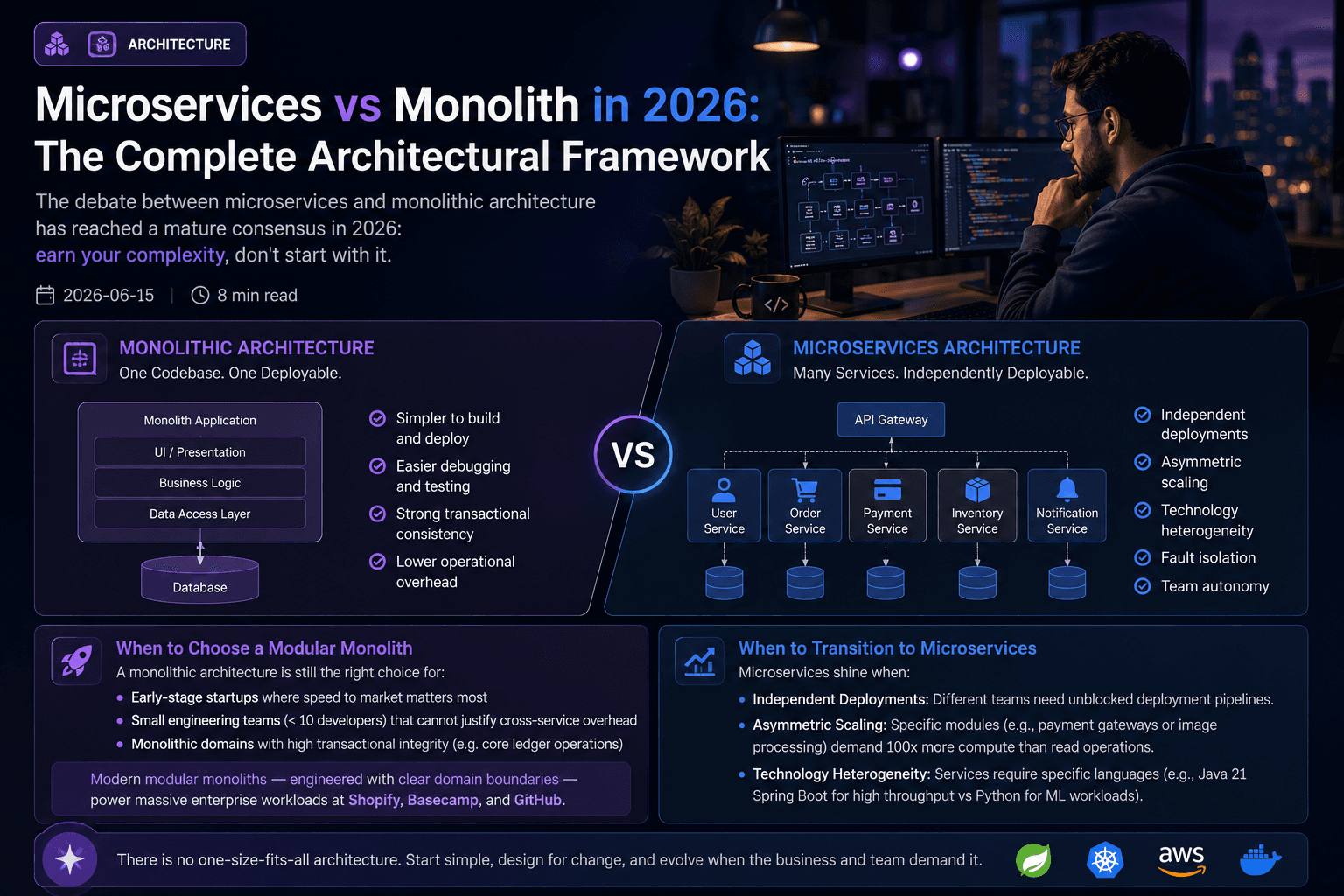
The debate between microservices and monolithic architecture has reached a mature consensus in 2026: earn your complexity, don't start with it.
The 2026 Reality Check
Frameworks like Spring Boot, NestJS, and Next.js have made single-process applications dramatically more capable. At the same time, managed platforms (Kubernetes, serverless, Dapr) made distributed systems easier to run — but never easier to reason about. The cost curve of distribution has not moved; it has merely been deferred.
What Is a Modular Monolith?
A modular monolith is a single deployable application with hard, language-enforced boundaries between business modules. Modules communicate through explicit interfaces — not through shared mutable state.
public interface OrderService {
  Order placeOrder(CreateOrderCommand command);
  OrderStatus statusOf(String orderId);
}
Dependencies point inward; modules never reach into each other's internals. This keeps the operational simplicity of a monolith while preserving most of the architectural discipline of microservices.
When to Choose a Modular Monolith
A monolithic architecture is still the right choice for:
- Early-stage startups where speed to market matters most.
- Small engineering teams (fewer than 10 developers) that cannot justify cross-service overhead.
- Monolithic domains with high transactional integrity, such as core ledger operations.
- Teams without operational maturity — no dedicated SRE, immature observability, or single-region deployments.
Modern modular monoliths — engineered with clear domain boundaries — power massive enterprise workloads at Shopify, Basecamp, and GitHub.
When to Transition to Microservices
Microservices shine when:
- Independent Deployments: Different teams need unblocked deployment pipelines.
- Asymmetric Scaling: Specific modules (e.g., payment gateways or image processing) demand 100x more compute than read operations.
- Technology Heterogeneity: Services require specific languages (e.g., Java 21 Spring Boot for high throughput vs Python for ML workloads).
- Fault Isolation: A failure in one domain must not cascade into another.
Cost Analysis
The decision is an economics problem as much as an engineering problem:
| Factor | Modular Monolith | Microservices |
|---|---|---|
| Infrastructure cost | 1x | 3-8x across clusters, networking, observability |
| Deploy complexity | Single pipeline | Orchestrated, multi-pipeline |
| Onboarding time | Days | Weeks to months |
| Cross-service debugging | Rarely needed | Daily occurrence |
| Team autonomy | Limited | Full ownership |
Distribution is a bet that the value of independent scaling and deployment exceeds the permanent tax on every developer interaction with the system.
SLA & Reliability Considerations
- A monolith fails atomically: one deploy, one health state, one on-call runbook.
- Microservices fail probabilistically: any of 40 services can degrade, each with its own latency tail.
- True availability is the product of every dependency's availability. Twenty 99.9% services give you roughly 98% end-to-end.
Plan SLOs per critical path, not per service.
Team Topology & Conway's Law
Systems mirror communication structures. If your organization is a single team, a single deployable is the honest architecture. Split services only when teams can take end-to-end ownership of a bounded domain — otherwise you inherit all the distributed cost with none of the autonomy benefit.
Migration Strategy: The Strangler Fig
Never rewrite from scratch. Extract capabilities incrementally:
- Identify the domain with the strongest scaling or ownership argument.
- Carve it behind a stable internal interface inside the monolith first.
- Extract it into a standalone service behind the same interface.
- Route traffic gradually; keep a feature flag to flip back.
- Delete the monolith's now-dead code path.
Real-World Case Studies
- Shopify: Runs a modular monolith for core commerce while decomposing edge capabilities (search, checkout) into services.
- Basecamp: Operates a famously productive monolithic architecture with 30+ engineers serving millions of users.
- GitHub: Migrated incrementally from a Rails monolith to a service-oriented model over years — not months.
Anti-Patterns to Avoid
- Distributed monolith: Services that cannot be deployed or reasoned about independently.
- Synchronous dependency chains: Five services in a request path negate every isolation benefit.
- Shared database: Two "services" writing to one schema are one system with extra hops.
Decision Framework
Ask these questions in order:
- Can one small team build and operate it? → Modular monolith.
- Do independent deploys drive revenue? → Consider services per domain.
- Does one module need 100x the compute of the rest? → Split that module only.
- Can we survive 99.9% per-service availability math? → If not, stay monolith.
Conclusion
Start modular, stay monolith as long as the numbers allow, and extract services surgically when a specific constraint — scaling, ownership, or isolation — forces the move. The winning architecture is the one your team can reason about at 3 AM.